Discover iSwim — Evolve
2026/10/06
From a Product to a Pattern System
An intimate garment may look like nothing more than a few pieces of fabric.
But once that fabric is worn on the body, the questions begin: Where should space be created? Where is support needed? Can the legs move freely at the groin? How much should the back piece cover? And where should each line travel across the body?
Since 2009, iSwim has continued refining these details.
Some designs have remained with us to this day. Some became the starting point for later structures. Others appeared first, then received the names and classifications we use today only years later.
iSwim’s patterns were not designed all at once.
They are an evolution that continues to this day.
NUDIST: Beginning with the Freedom of Feeling Almost Nude
NUDIST was born on February 5, 2010.
The original idea was simple:
Let the body rest naturally, with gentle support and a sense of freedom close to being nude.
NUDIST was therefore never simply about making the pouch larger. It was an attempt to create genuine three-dimensional space for the body from a flat front piece.
Over the following years, NUDIST developed in several different directions.
NUDIST U, NUDIST 2, NUDIST J, NUDIST G, and NUDIST sculp each explored different curves, spaces, and forms of support. Some became the starting points for later structures, while others remain with us today.
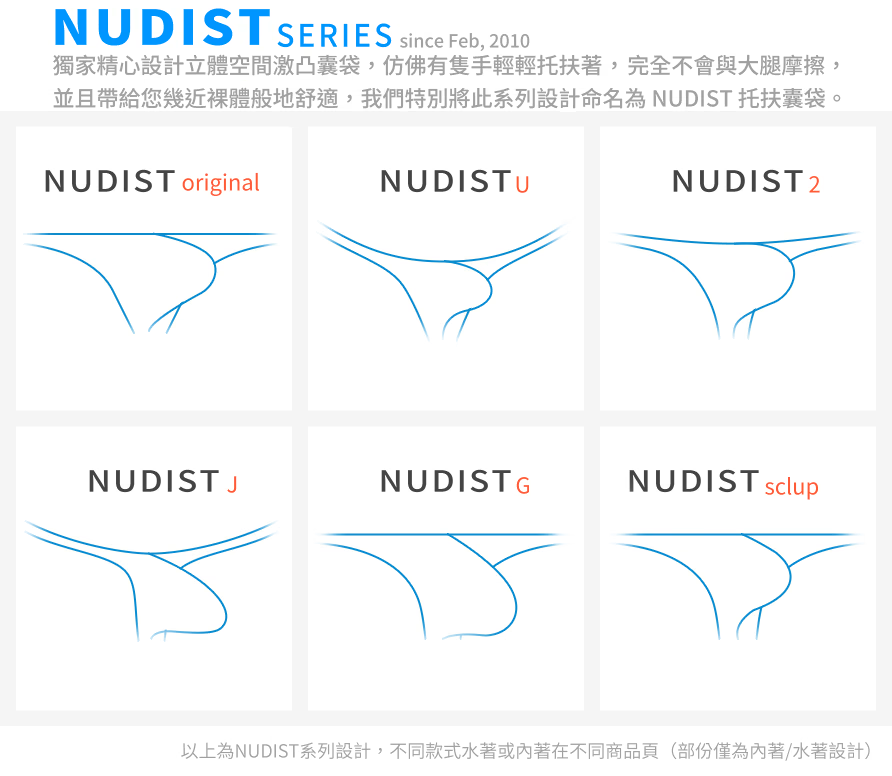
In 2017, NUDIST entered Gen 3.
Today, iSwim continues to use the third-generation NUDIST as its primary structure, while Mini NUDIST extends the concept with a narrower front piece.
NUDIST has changed many times since 2010, but the original question has never changed:
How do we support the body while preserving its natural space?
EU: An Idea That Began with a One-Piece Design
In 2013, iSwim created an extremely low-cut U-shaped one-piece design.
13u381 had an unusual appearance, but the garment itself was not the only thing that remained from the experiment.
To make the U-shaped lines lower and narrower, the sides of the front-piece pouch were also reduced dramatically. We discovered that reducing fabric at the sides gave the leg roots more freedom to move, while the three-dimensional space needed at the front could still be preserved.
This became an important idea behind EU (Extreme U-style):
A narrower front piece does not mean the pouch space has to become smaller too.
The idea first explored in this one-piece design was later brought into regular underwear.
In 2014, 14u570 combined ultra-narrow sides with a spacious pouch, becoming the predecessor of what would later be called Magic Bulge.
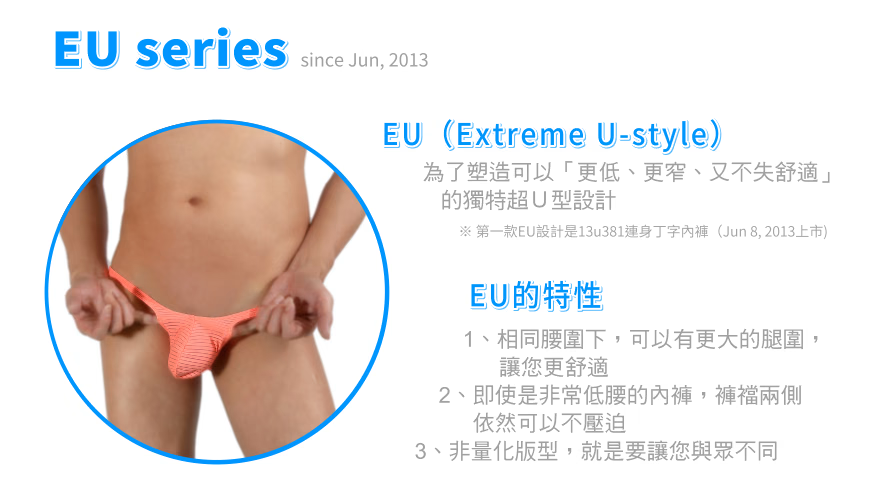
In 2018, Magic Bulge officially launched under that name.
From then on, the Magic structure also became an important foundation for many later iSwim front-piece designs. The focus was no longer simply how much capacity there was at the front, but how to treat the space needed at the leg roots separately from the space needed in the pouch.
The Same Amount of Space Can Take Different Shapes
Size alone does not define a front piece.
The swying pouch that appeared in 2012 later developed into ROCK, while the 2013 NUDIST J continued its evolution into what would become SWAY.
Both provide a larger pouch with similar capacity, but they create that space in different ways.
ROCK uses a lower-seam construction to create more space. Because there is no vertical seam in the upper front piece, the upper section sits closer to the body.
SWAY retains a central vertical seam, allowing the upper part of the pouch to maintain a more pronounced curve.
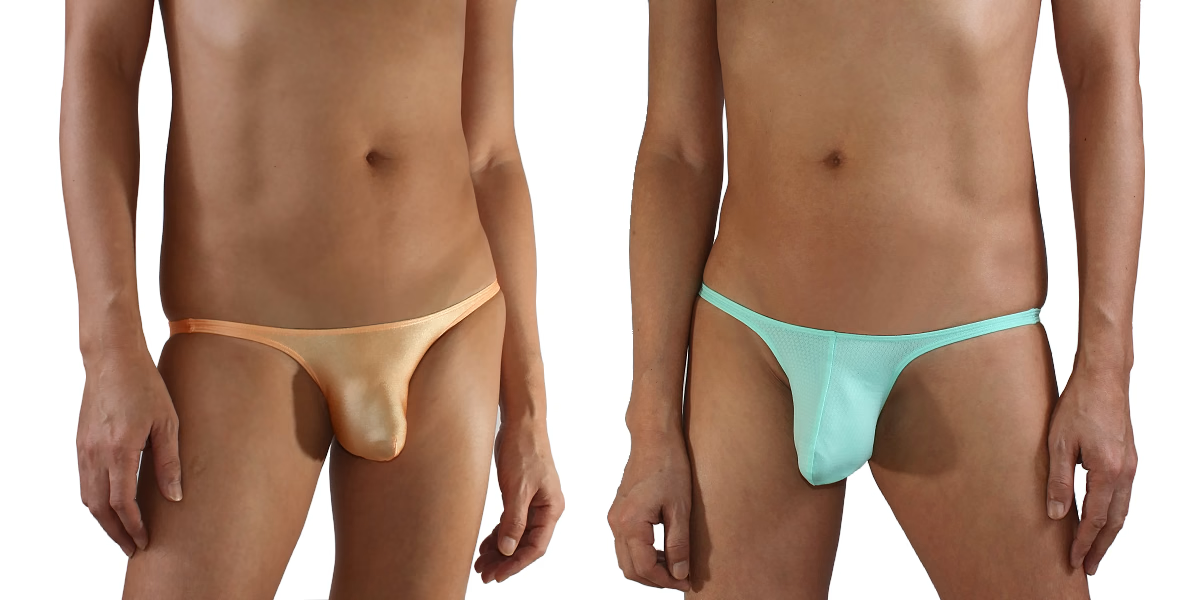
In 2017, these two structures, which had already been developing for years, were formally named ROCK and SWAY.
With similar capacity but different seam positions and curves, they create different spaces and contours once worn on the body.
Torus, introduced in 2020, represented another exploration of front-piece structure.
By this point, iSwim pouches could no longer be described simply as “larger” or “smaller.”
The real difference is where the space is created, and how that space is formed.
The Evolution of the Back Piece Was Never Just About Using Less Fabric
iSwim officially went on sale on November 18, 2009.
Basic structures such as briefs and thongs already existed at the time, but over the next few years, the back piece quickly began to evolve in different directions.
By the end of 2009, the Brazilian thong had already appeared.
In 2010, we began experimenting with ruching, which gradually matured in 2011. That same year also saw the appearance of the Y-back thong and a one-piece open-back lifting structure.
In 2012, narrow-bottom half-coverage backs, smile briefs, and smile half-coverage backs introduced still more lines and structures.
Some increased coverage, while others reduced fabric. Some used ruching and tension to help a flat back piece follow the curves of the buttocks more closely, while others changed the path the lines took across the body altogether.
The evolution of the back piece was therefore never simply about making it smaller and smaller.
Less fabric is not the basis of classification. What matters is how the back piece travels across the body.
Half Coverage and Thongs Differ by More Than Width
This later became an important dividing line when iSwim organized its back-piece structures.
A narrow-bottom half-coverage back piece can be extremely narrow, yet it still covers the buttocks and does not enter the gluteal cleft.
A Brazilian thong is different: the back piece gradually narrows and enters the gluteal cleft.
So in iSwim’s pattern classification, whether a back piece is considered a thong is not determined by how much fabric it uses, or simply by how narrow it looks.
Whether it enters the gluteal cleft is the key structural distinction between half coverage and a thong.
This distinction later became an important foundation for organizing different back-piece structures such as A, C, Y, and V.
From Free Combination to Rebuilding the Rules
Between December 2012 and October 2016, iSwim offered combination-custom designs.
Customers could freely select different back pieces and fabrics to create the combinations they wanted.
This experience led us to ask an important question very early on: Does a pair of underwear really need to have only one fixed answer?
But the more combinations we made, the more clearly we saw another problem:
Just because pieces can be freely combined does not mean every combination will work on the body.
Different front pieces and back pieces have their own heights and lines. Combining them freely can create mismatched front and back heights. Fabrics also differ in stretch, support, and extension, so the same material is not necessarily suitable for every pattern.
More options do not necessarily mean a better fit.
By 2016, we had developed nearly 70 samples for the next stage.
In the end, we abandoned all of them.
Because the real problem was no longer how to add a few more choices. What we needed was a new set of rules:
Which structures can work together? How should different rises correspond? Which differences should become stable patterns instead of being recombined from scratch every time?
In 2017, iSwim began a major restructuring of its patterns.
Different back-piece structures such as F, B, H, and A, along with classifications that continued to develop later, were reorganized. At the same time, three rises—1, 2, and 3—were established.
From this point on, “free combination” gradually evolved into a structured pattern system governed by clear rules.
The Designs Came First. The System Came Later.
The changes of 2017 do not mean that all of these patterns were first created that year.
Half-coverage backs, Brazilian thongs, Y-backs, open-back structures, and even many different front-piece structures had already existed for years.
What changed was that these accumulated designs began to gain clearer structures, classifications, and relationships with one another.
That same year, NUDIST entered Gen 3, while ROCK and SWAY received their new names.
The designs came first. The classifications came later.
The codes were not created simply to give products more names. They made it possible to describe, select, and extend patterns developed over many years with greater clarity.
This also became the foundation that eventually made iSwim’s semi-custom system possible.
When a Single Line Can Become the Back Piece
In 2019, 19u4024-S1 appeared.
In S1, the waistband and rear G-string are formed by one continuous line.
By this stage, a back piece no longer had to be a conventional piece of fabric. A single line itself could determine how the back structure travels across the body.
In 2021, the V1 V-string appeared.
V and Y have very similar central back structures. The main differences are the angles of the side lines and the waistband length. V1 raises the side lines and uses a waistband 2 inches longer than Y1, allowing the lines to travel over a fuller, more three-dimensional curve of the buttocks instead of cutting directly across their fullest point.
This change was originally developed for fuller or more prominent buttocks, as well as the needs of gym users and certain Western body types.
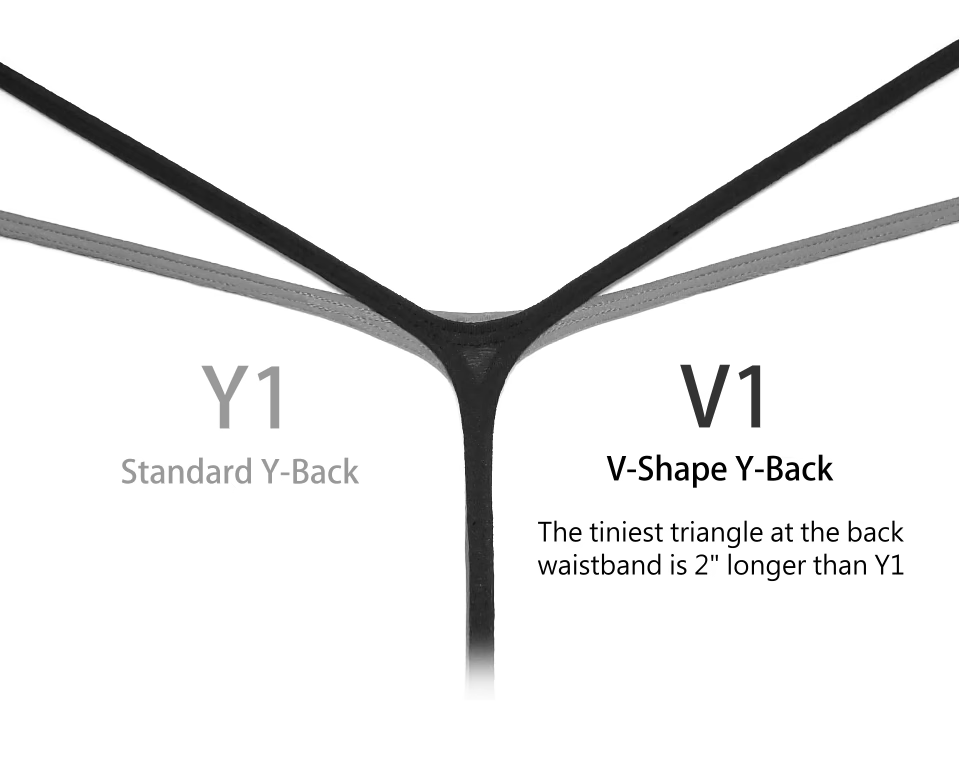
In 2022, V1 was further developed into a V-shaped thong using a true 15 mm waistband.
The same back-piece structure can therefore form different product categories depending on waistband width.
Sometimes evolution does not require redrawing an entire pattern piece.
Change a single angle, and the result on the body can be different.
Open-Back Does Not Mean “Two Thongs”
Another direction of development was the open-back structure.
As early as 2011, iSwim had already introduced a one-piece open-back lifting structure.
It was not made by sewing two separate straps together. Instead, a large central opening was formed within one continuous back piece.
Later, lines themselves also began to form open-back structures.
In 2022, 22u4045 took this further: the same one-string structure can be worn open-back, or by changing the path of the line across the body, it can become a thong.
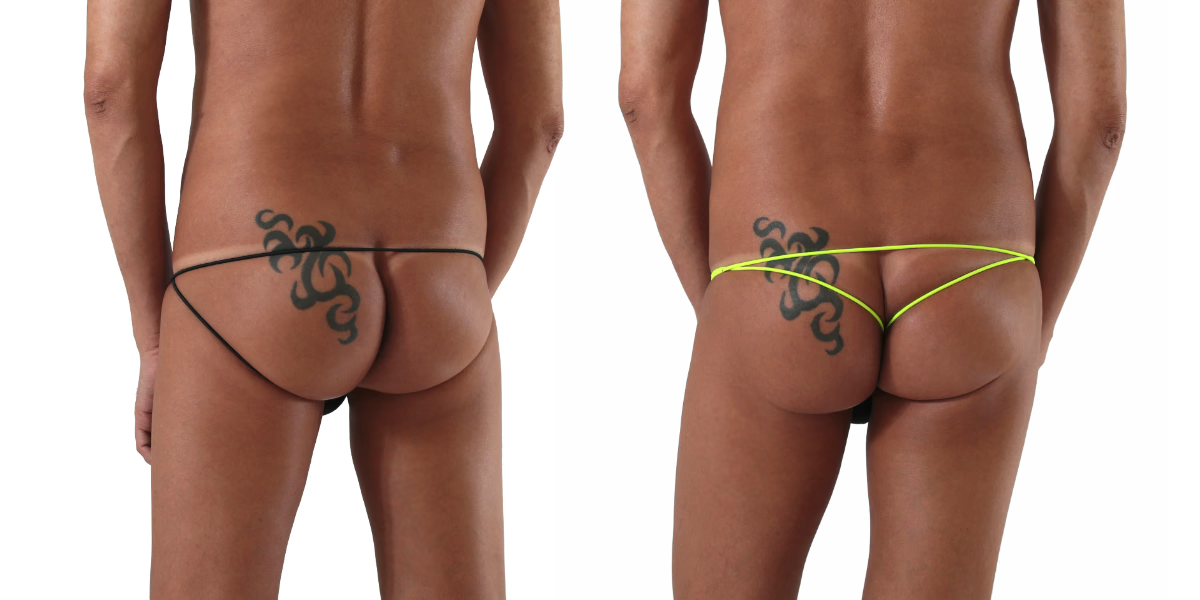
This also explains why iSwim does not determine whether something is a thong by counting how many lines appear at the back.
Similar designs are sometimes described in the market as “double thongs,” but in iSwim’s classification:
A line has the structural meaning of a thong only when it enters the gluteal cleft.
Open-back describes the structure and the way the back is opened—not how many lines appear at the back.
Why Is the Highest Rise Called 0?
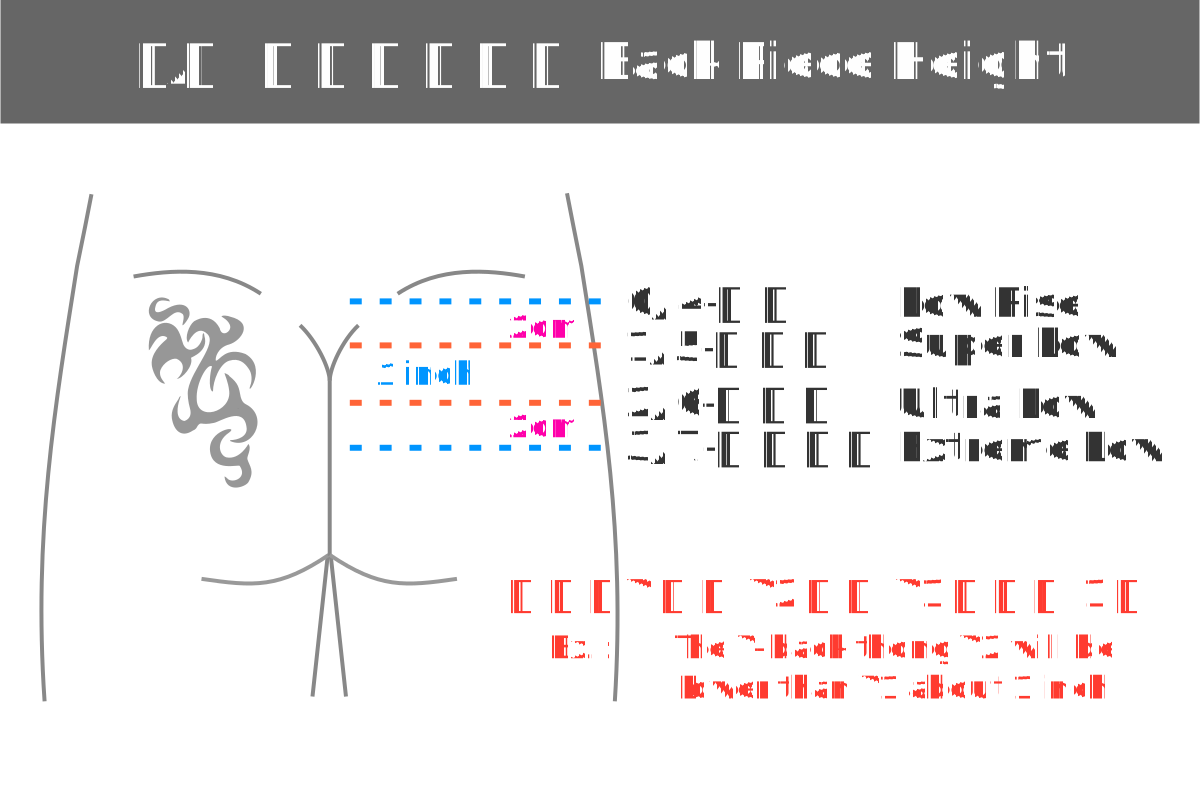
When iSwim reorganized its patterns in 2017, three different rises—1, 2, and 3—were established.
At the time, many customers in Europe and North America were discovering iSwim through Tumblr and began asking for different ways to wear our designs. One request was especially clear: they wanted an option higher than the existing rises.
So in 2018, we added 0 before the existing 1, 2, and 3, creating the 0, 1, 2, 3 four-rise system that remains in use today.
0 is the highest. 3 is the lowest.
It is called 0 because it was inserted before the existing 1, 2, and 3 rather than renumbering the entire system.
On June 1, 2021, iSwim further standardized the relationship between the waistline and hip line across the different rises.
The rise can change, but the hip line that actually affects how the back piece fits does not need to move proportionally with it.
From this point on, “rise” and “back-piece structure” could be treated more clearly as separate variables.
From Products to a Pattern Language
Looking back over more than a decade of change, it is difficult to draw a simple timeline in which every old design was replaced by a new one.
NUDIST has continued evolving since 2010, and some of its earlier structures still exist today. Brazilian thongs, ruching, Y-backs, and open-back structures did not suddenly appear only after the classification system was established.
New designs did not eliminate all the old ones.
They simply answered different questions.
The front piece deals with how space is formed, how the body is supported, and how freedom of movement is maintained at the leg roots.
The back piece deals with coverage, the curves of the buttocks, and how lines should travel across the body.
Rise, waistline, and hip line determine where those structures ultimately sit on the body.
From individual early products, to free combinations, and then to rebuilding the rules, more than a decade of experimentation gradually became a pattern language.
With that language in place, the next question emerged:
How can the same pattern system fit different bodies?
Next: Discover iSwim — Fit
 LINE
LINE Weixin